A few weeks ago, I took it upon myself to curate a survey for the pupils in my boarding house. This was inspired by a Geography project I did a couple years back, where we were tasked with creating a poster with pictures of our favourite pieces of clothing and their ‘Made In’ labels. When preparing the survey, I tried desperately to find the original copy of my poster for inspiration – asking my teachers and scouring my room – but unfortunately, I was unsuccessful.
I pushed through with my plans, however, creating a survey which I sent around. Around the same time, I was also elected as my school’s Sustainability Officer, therefore there are a few questions that are perhaps unrelated to the title of this article and instead assist my endeavors in that project. Regardless, I was mainly interested in the final ask: “Pick a few pieces of your most worn clothing, and tell me where it was made in.”
After a couple days, the form received 22 responses. Disappointing, I know. Considering my house has 80 pupils, a 25% turnout did not provide me with the most accurate ‘evidence’. Still, I was eager to look at the results.
The first question was rather straightforward. “Are you aware of what sustainable fashion is?” Honestly, I was rather shocked with the results: 5 out of 22 were unsure, or didn’t know at all about sustainable fashion. I thought it would be slightly self-explanatory, and yet, 20% weren’t a full-blown ‘yes’! This demonstrated to me, though, the necessity in spreading awareness. All five of them were in the 11-14 age group, emphasising the importance in educating the younger population, especially as they grow older.
Next, I asked “How often do you purchase new pieces of clothing?”
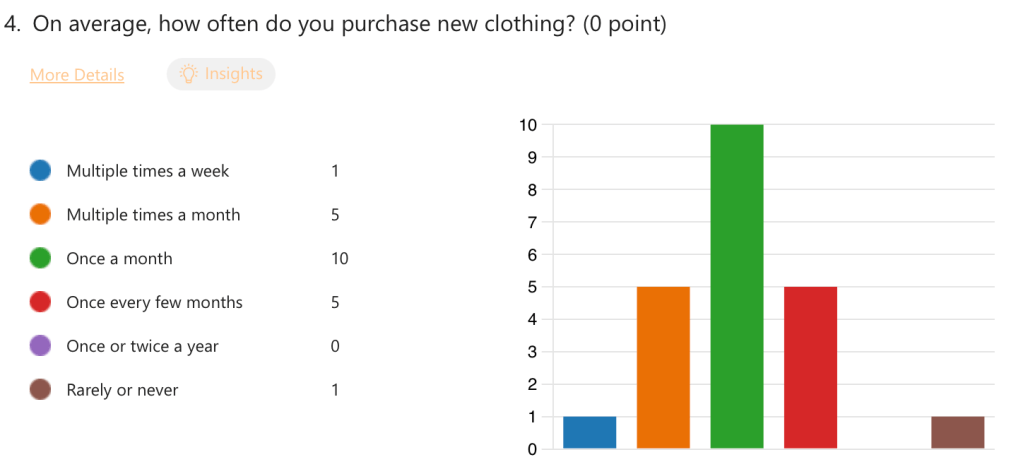
There were quite mixed results. Of course, this question is likely to be more accurate with a greater sample size, however, it was interesting to me to see the curve. One participant was quite frequent with their purchasing, selecting ‘Multiple times a week.’ (Insane.) Another was more diligent, selecting ‘Rarely or never.’ However, considering the sheer amount of different articles of clothing I see each week on our Saturday Mufti days, I know many pupils at my school play a big role in the ongoing cycle of the fashion industry.
What I found the most interesting, apart from the ‘Made In’ results, was the question “What factors influence your clothing purchasing decisions?”
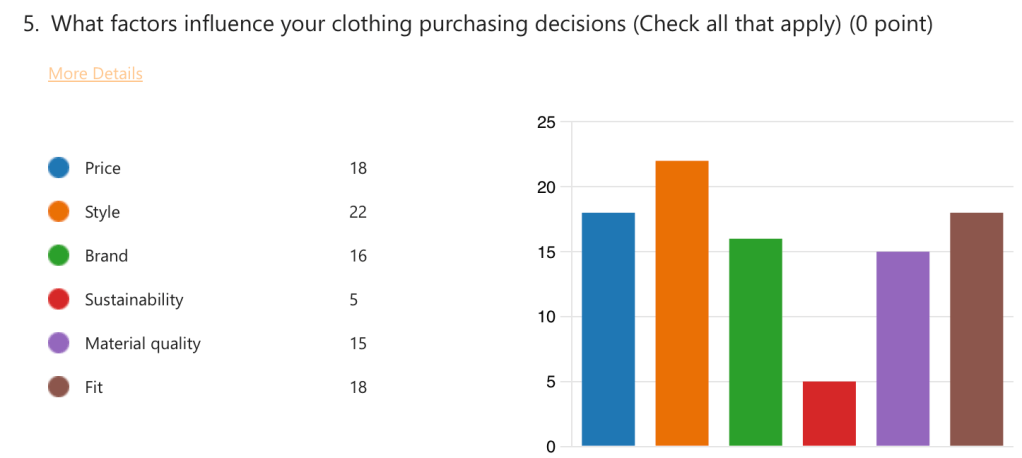
Now the results of this question were obvious. It is clear from the visual demonstration that sustainability ranked considerably lowly – with only five people choosing that they prioritised sustainability. The second lowest result – material quality – still had 10 more people selecting it (nearly 50%).
This is greatly disappointing. For an industry with such high involvement from nearly everyone on the planet, if such a limited number even consider sustainability in their purchases, how can we hope for a sustainable future?
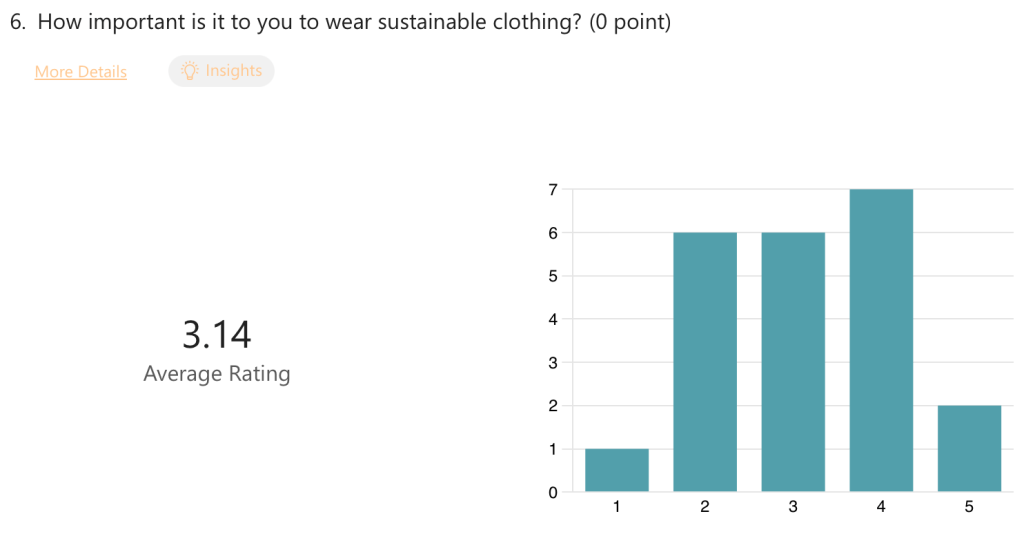
A 3.14 rating is decent, for the following question: “How important is it to you to wear sustainable clothing?”. A fair share of participants selected 4 stars, however the fact that it remains more of a equal triangle than biased towards the right demonstrates the urgent need for some sort of systematic change in peoples’ opinions towards fashion.
Now, onto the answers of the final question, which I know (hope!) you have all been waiting for.
Drum roll…
The overwhelming consensus was China, with 16 (73%) of people inputting the country. The format of the question is perhaps slightly misleading, as many of the people who included China in their answer wrote things such as ‘China x 5’, ‘China x4, and so on. Bangladesh and Turkey were also popular.
I found this immensely interesting. A while ago I wrote articles on the labour situation in both Bangladesh and Turkey, and felt incredibly dejected realising that the people around me, and even myself, have clearly contributed to the reasoning behind the disasters which had previously occurred. This survey demonstrated to me, evidently, the immense effect which we have on those around us. I find that it is natural proclivity for many humans to refuse to be the change makers of the world, instead relying on others and deeming their contribution too insignificant to be worthwhile. But, it’s clear this needs to change. Only we can unwrite the damage we’ve been causing.
 Sydney's Blog
Leave a comment